



In short,
- De Quervain’s tenosynovitis causes pain on the thumb side of your wrist.
- Splints and therapy often relieve symptoms.
- Consult a doctor if pain persists despite home care.
De Quervain’s tenosynovitis causes pain on the thumb side of the wrist, but it’s important to know that under a doctor’s care, you may be able to try therapy for De Quervain’s tenosynovitis. Understanding the condition, its causes, and treatments is important for relief.
The Bone & Joint Center creates custom treatment plans to help with all types of wrist pain, including De Quervain’s tenosynovitis. Our goal is to help you heal and return to your activities without invasive or unnecessary procedures.
Understanding De Quervain’s Tenosynovitis
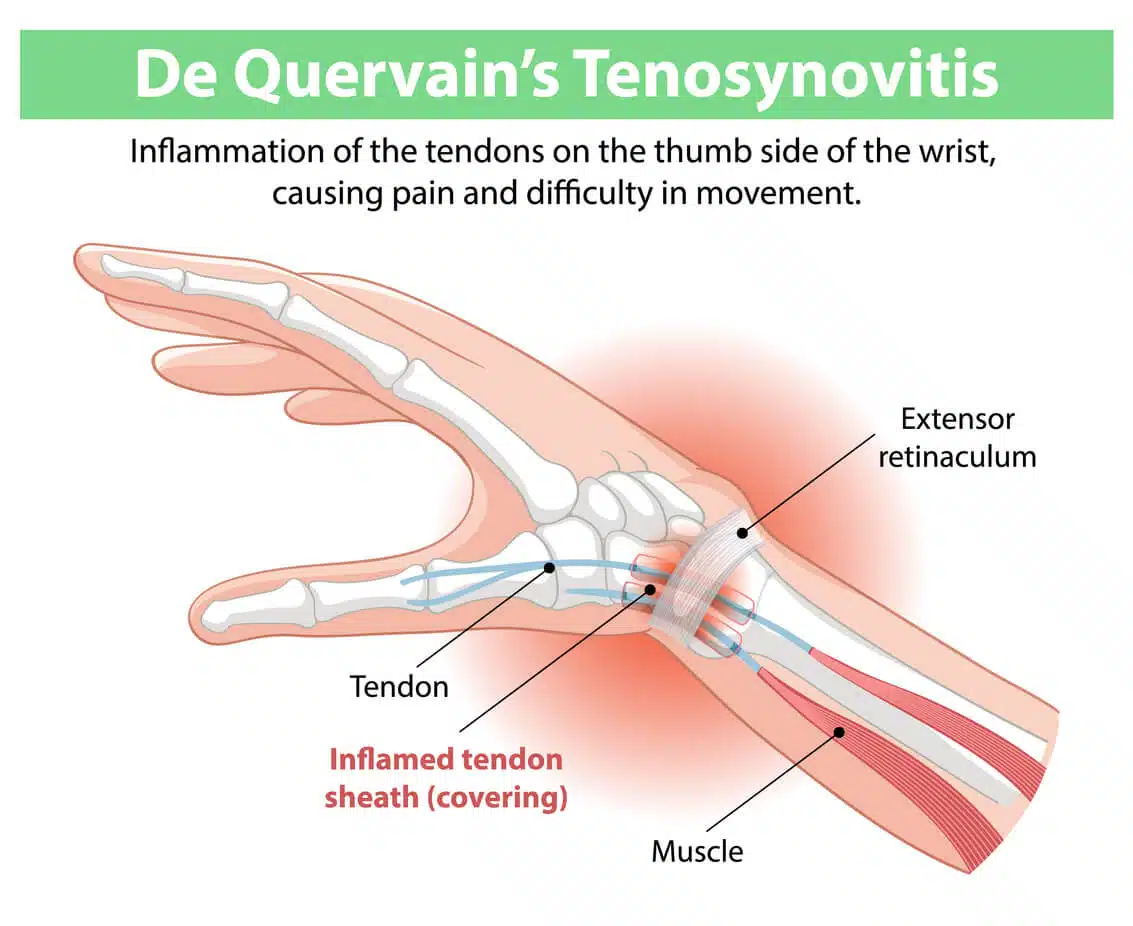
De Quervain’s tenosynovitis affects the tendons on the thumb side of your wrist, and according to the National Institutes of Health, it affects women more than men, with a prevalence of 0.5% in men and 1.3% in women. It involves inflammation of the tendons, making hand and wrist movements difficult.
- Affects tendons on the thumb side of the wrist.
- Involves inflammation.
- Narrows the tendon sheath, causing pain.
Anatomy Involved
The abductor pollicis longus (APL) and extensor pollicis brevis (EPB) tendons are affected. These tendons are important for thumb movement.
- Abductor pollicis longus (APL) and extensor pollicis brevis (EPB) tendons are affected.
- These tendons run along the thumb side of the wrist.
- Inflammation restricts tendon movement.
Causes and Risk Factors
Several factors can lead to De Quervain’s tenosynovitis. Recognizing these can help with prevention.
Repetitive Hand Movements
Repetitive hand and wrist movements are a main cause, leading to irritation of the tendons. Activities like gardening, hammering, or lifting a baby can be triggers.
- Repetitive motions can contribute.
- Activities like gardening or lifting can be triggers.
- Repetitive movements cause friction.
Underlying Medical Conditions
Certain medical conditions can increase the risk. Inflammatory conditions like rheumatoid arthritis and diabetes may be factors.
- Inflammatory conditions like rheumatoid arthritis can increase the risk.
- Diabetes may also be a factor.
- These conditions make tendons more susceptible to inflammation.
Hormonal Changes and Pregnancy
Hormonal changes, especially during pregnancy, can contribute. These changes can cause fluid retention and swelling. Postpartum mothers who frequently lift and carry their infants are also at increased risk.
- Hormonal changes during pregnancy can cause fluid retention.
- Postpartum mothers who lift infants are at increased risk.
- These stressors can contribute.
What are Some of the Symptoms and Warning Signs?
Recognizing the symptoms is important for early diagnosis and therapy for De Quervain’s tenosynovitis. Common symptoms include pain, swelling and tenderness, and stiffness.
Pain and Tenderness
Pain is the most common symptom, typically felt on the thumb side of the wrist. The area may be tender to the touch, and pain can worsen with movement.
- Pain is felt on the thumb side of the wrist.
- The area may be tender.
- Pain can worsen with movement.
Swelling and Stiffness
Swelling and stiffness can also occur, limiting the range of motion. Visible swelling may be present, and a feeling of “catching” may occur when moving the thumb.
- Visible swelling may be present.
- Stiffness can make tasks difficult.
- A feeling of “catching” may occur.
Finkelstein Test
The Finkelstein test is used to diagnose De Quervain’s. Make a fist with your fingers over your thumb, then bend your wrist toward your little finger. Sharp pain suggests De Quervain’s.
A common way to check for De Quervain’s involves bending your wrist with fingers over your thumb. If you experience sharp pain, it suggests De Quervain’s.
Diagnosis and Testing
Diagnosing De Quervain’s typically involves a physical exam. Imaging tests are sometimes used to rule out other conditions.
Physical Examination
A physical exam is the first step for diagnosis. The doctor will assess your symptoms, range of motion, and perform the Finkelstein test. They will also check for swelling and tenderness.
- Assess symptoms and range of motion.
- Perform the Finkelstein test.
- Check for swelling and tenderness.
Imaging Tests
Imaging tests aren’t always needed, but they can be helpful. X-rays may be used to rule out other conditions, while ultrasound imaging can visualize the tendons.
- X-rays may rule out other conditions.
- Ultrasound imaging can visualize tendons.
- MRI scans are rarely needed.
Differential Diagnosis
It’s important to differentiate De Quervain’s from other conditions that can cause similar symptoms, such as carpal tunnel syndrome or thumb arthritis.
- Rule out conditions like carpal tunnel syndrome or thumb arthritis.
- The doctor will consider your medical history.
- Proper diagnosis is crucial.
Treatment Options and Management
Treatment for De Quervain’s tenosynovitis aims to reduce pain and inflammation, and restore normal function. Options range from non-surgical approaches to surgery.
Non-Surgical Treatments
Non-surgical treatment for De Quervain’s tenosynovitis are often the first step. Resting the affected hand and wrist is important. Wearing a splint or brace can help immobilize the thumb and wrist. Ice packs can be applied to reduce swelling and pain.
- Rest the affected hand and wrist.
- Wear a splint or brace.
- Apply ice packs.
Therapy for De Quervain’s Tenosynovitis
Physical and occupational therapy for De Quervain’s tenosynovitis can help improve range of motion, strength, and function. Therapeutic exercises can strengthen the muscles around the wrist and thumb. Occupational therapy can teach you how to modify your activities.
- Physical therapy can improve range of motion and reduce pain.
- Therapeutic exercises can strengthen muscles.
- Occupational therapy can teach activity modification.
Medications
Medications can help manage pain and inflammation. Over-the-counter pain relievers like ibuprofen or naproxen can help. Corticosteroid injections can provide temporary relief.
- Over-the-counter pain relievers can help.
- Corticosteroid injections can provide temporary relief.
- Talk to your doctor about the risks and benefits.
Prevention and Lifestyle Changes
Preventing De Quervain’s involves making lifestyle changes and ergonomic adjustments.
Ergonomic Adjustments
Making ergonomic adjustments to your workspace can help. Adjust your workstation to ensure proper posture. Use ergonomic tools and equipment. Take frequent breaks to stretch.
- Adjust your workstation for proper posture.
- Use ergonomic tools and equipment.
- Take frequent breaks to stretch.
Are There Activity Modifications?
Modifying your activities can help. Avoid repetitive hand and wrist movements. Use proper techniques when performing tasks. Alternate activities to prevent overuse.
- Avoid repetitive hand and wrist movements.
- Use proper techniques.
- Alternate activities.
Stretching and Strengthening Exercises
Regular stretching and strengthening exercises can help. Regularly perform stretching exercises. Strengthening exercises can help support the muscles around your wrists and thumbs.
- Perform stretching exercises.
- Strengthening exercises can help support muscles.
- Consult with a physical therapist for guidance.
When to Seek Professional Therapy For De Quervain’s Tenosynovitis
Knowing when to seek professional therapy is important. Persistent pain, limited range of motion, and numbness or tingling are all reasons to seek medical attention.
Persistent Pain
If you experience persistent pain despite home care, it’s important to seek professional therapy. Worsening pain that interferes with your daily activities warrants a visit to the doctor.
- Pain persists despite home care.
- Worsening pain interferes with daily activities.
- Early intervention can prevent the condition from becoming chronic.
Limited Range of Motion
Limited range of motion is another reason to seek professional therapy. Difficulty performing simple tasks can indicate a more severe problem.
- Significant limitations in range of motion.
- Difficulty performing simple tasks.
- A doctor can assess your condition.
Numbness or Tingling
Numbness or tingling may indicate nerve involvement and should be evaluated by a healthcare professional. These symptoms can be a sign of carpal tunnel syndrome.
Numbness or tingling may indicate nerve involvement and could be a sign of carpal tunnel syndrome. Seek medical attention to determine the cause.
Finding Therapy For De Quervain’s Tenosynovitis in Bismarck, North Dakota
If you are experiencing symptoms, seeking timely treatment is essential. The team at the Bone & Joint Center provides individualized treatment and therapy for De Quervain’s tenosynovitis and related wrist pain and/or bone or joint issues.
Call us today at (701) 946-7400 to get in touch and schedule your first meeting with one of our caring and experienced providers.
